
"coffee metrics"
400 article(s) found

The relationship between Burmese Blue Mountain Coffee Manor and Blue Mountain Coffee? What is S795 coffee?
For more information on coffee beans, please follow the coffee workshop (Wechat official account cafe_style) Blue Mountain Coffee Manor is located on a scenic steep slope of 1200 1400 meters above sea level, with an aerial view of the town of Pyin Oo Lwin, the surrounding scenery is as famous as the award-winning gourmet coffee of the same name. Its coffee beans are SL-34 bourbon species from Kenya.

Talk about Certification │ UTZ Certification ─ and the Sustainable Future of World Coffee
Professional baristas please pay attention to the coffee workshop (Wechat official account cafe_style) UTZ certification and the sustainable future of world coffee UTZ certification organization has a strict traceability system for every link of the supply chain, adhere to provide consumers with the most complete production resume. Compared with the current consumer demand, I am more concerned about the safety and protection of the product than the price factor.

What are the common types of defective beans in raw coffee? the effect of defective beans on coffee
Professional coffee knowledge exchange more coffee bean information please follow the coffee workshop (Wechat official account cafe_style) according to the statistics of the International Coffee Organization (ICO), there are about 1.5 million metric tons of defective beans worldwide in a year. Defective beans will be consumed by the producing countries or transferred to low-cost formula beans, made into comprehensive coffee beans or sold cheaply to instant coffee factories to make three-in-one coffee and so on. Mixed bitter taste

What are the coffee producing areas in Ecuador? How to rinse and boil the soybeans from the producing area of Samora, Ecuador
Professional coffee knowledge exchange more coffee bean information please follow the coffee workshop (Wechat official account cafe_style) which coffee producing areas in Ecuador? How to rinse and boil beans from Ecuador's Samora region? Coffee cultivation in Ecuador covers an area of 305.000 hectares, of which Arabigo coffee accounts for 68 per cent and Robusta coffee accounts for 32 per cent. Coffee

How to brew Indian monsoon malaba coffee? History of different regions of India Coffee bean flavor differences
Coffee from the Malabar region of southern India is treated by wind and sun, which will be introduced in the next section of the knowledge popularization and introduction. The acidity of this coffee is low and the taste is very special. Here's how to make this type of coffee. Recommended cooking method: hand brewing filter cup: KONO filter cup water temperature: 87-88C powder amount: 15 g powder water ratio: 1:1

The introduction of the nine boutique producing areas in Ethiopia, the parameters of the Lion King hand Chong in Xidamo
Ethiopian name: Ethiopia location: East African Capital: Adis Abba Addis Ababa Religion: Christian main language: Amharic time Zone: GMT+3 Metrology: metric (Metric) currency: bill Birr (1 $20 birr) Agricultural products (export): coffee, flowers, sesame are the main cash crops export port: Djibouti, now

Knowledge of Jamaican coffee beans: why is Blue Mountain coffee filled in wooden buckets?
Professional coffee knowledge exchange more coffee bean information please follow Coffee Workshop (Wechat official account cafe_style) Blue Mountain (Blue Mountain) Coffee is a coffee bean brand grown in a limited area in the Blue Mountains of Jamaica at an altitude of 800-1200 meters. It usually grows on steep slopes, sometimes as high as 60 degrees and requires manual mining. It is characterized by its very high fragrance.

A brief introduction to the cultivation of clean and rich Mazu coffee in Alishan, Taiwan, geographical location, climate and altitude
It is a pity that Taiwan is too small, and the total annual coffee output is less than 700 metric tons, not to mention the scarcity of beans awarded in the Alishan competition, which has become a boutique growing place for experts all over the world. During the coffee growing period of 130 years in Taiwan, Taiwan has produced eight major production areas. Now, in addition to producing boutique coffee that captivates the world's masters, many more have been bred in this land.
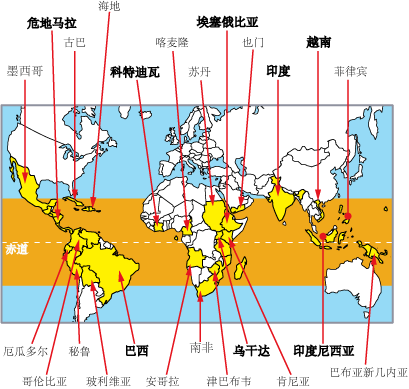
Coffee producing area worldwide 53 coffee producing area Guadeloupe Guadeloupe
Guadeloupe's good coffee production has been affected by natural disasters. The Caribbean islands used to be important producers of coffee. In 1789, more than 1 million coffee trees on 500 hectares of land produced 4000 tons, but today, only 150 hectares of land is used to grow coffee. This decline can be attributed to the increase in sugar cane and banana production and Hurricane Hu in 1996.
World Coffee boutique Manor beans: Guadeloupe Guadeloupe, an overseas province of France
Good coffee production has been affected by natural disasters this group of islands in the Caribbean used to be an important producer of coffee. In 1789, more than 1 million coffee trees on 500 hectares of land produced 4000 tons, but today, only 150 hectares of land is used to grow coffee. This decline can be attributed to the increase in sugar cane and banana production and Hurricane Hurricane In in 1996.

As of March 2017, Saudi Arabia's coffee exports totaled US $37.9 million.
Professional baristas follow the coffee workshop (official Wechat account cafe_style) the coffee committee (CSC) said that coffee exports and exports in the year to March 2017 increased by 7.5% and 3.3%, respectively, compared with the same period in 2016. Hugo Hernandez, chief executive of the committee, said that coffee exports from Saudi Arabia totaled US $37.9 million in the year to March 2017, the World Daily reported.

The export price of Nicaraguan coffee is growing high.
For the exchange of professional baristas, please follow the coffee workshop (Wechat official account cafe_style). According to the Nicaraguan Export Exchange Center (Cetrex) statistics, in the current harvest year (October 1, 2016 to September 30, 2017), Nepalese coffee exports exceeded 2.8 million piculs by the end of August, an increase of 18.6% over the same period last year. Cetrex pointed out that during the 11-month period mentioned above, Nicaraguan coffee

How about Tanzanian coffee? how's Tanzanian coffee? is Tanzanian coffee good?
Professional coffee knowledge exchange more information about coffee beans Please follow the coffee workshop (Wechat official account cafe_style) in Tanzania, coffee is the second most valuable agricultural export product after tobacco. The economy of this country is mainly based on agriculture

Ethiopia Yega Sherphine Waka Co-op Jedip Wash G1 Flavor Taste Aroma Description
For professional barista communication, please pay attention to coffee workshop (Weixin Official Accounts cafe_style)[Ethiopia Yegacheffe Coffee Jietip Washing G1] Coffee Review #94 Fenwoka Cooperative belongs to YCFCU Coffee Farmers Cooperative Union. Founded in 2005, Woka Cooperative is located in Yega

Per capita coffee consumption in the United Arab Emirates has tripled
According to the latest statistics released by the International Coffee Organization, tea and coffee consumption in Arab countries has more than tripled in the past decade. Consumption in the United Arab Emirates has increased by 85% in the past three years. The per capita annual consumption of tea and coffee in the United Arab Emirates is 3.5 kg, which is about double that of other Gulf countries, and tea consumption has increased by 47%. 2011 Global Coffee

The world's largest coffee producer The world's largest coffee exporter The world's largest coffee producer
Professional coffee knowledge exchange More coffee bean information Please pay attention to Coffee Workshop (Weixin Official Accounts cafe_style) Brazil- 2,595,000 metric tons (5,714,381,000 pounds) Brazil is the world's largest coffee producer. In 2016, Brazil produced a staggering 2.595 million tons of coffee beans. This is not a new development, as Brazil is the world's largest producer of coffee beans for over 150 years.

Consumption of tea and coffee in Arab countries has more than tripled
According to the latest statistics released by the International Coffee Organization, tea and coffee consumption in Arab countries has more than tripled in the past decade. Consumption in the United Arab Emirates has increased by 85% in the past three years. The per capita annual consumption of tea and coffee in the United Arab Emirates is 3.5 kg, which is about double that of other Gulf countries, and tea consumption has increased by 47%. 2011 Global Coffee

Consumption of tea and coffee in Arab countries has more than tripled
According to the latest statistics released by the International Coffee Organization, tea and coffee consumption in Arab countries has more than tripled in the past decade. Consumption in the United Arab Emirates has increased by 85% in the past three years. The per capita annual consumption of tea and coffee in the United Arab Emirates is 3.5 kg, which is about double that of other Gulf countries, and tea consumption has increased by 47%. 2011 Global Coffee
Consumption of tea and coffee in Arab countries has more than tripled
The consumption of tea and coffee in Arab countries has increased more than threefold over the past decade, according to the latest statistics released by the International Coffee Organization. Consumption in the United Arab Emirates has increased by 85 per cent over the past three years. Annual per capita consumption of tea and coffee in the United Arab Emirates is 3.5 kg, coffee consumption is about twice that of other Gulf countries, and tea consumption has increased by 47%. Global Coffee 2011

Consumption of tea and coffee in Arab countries has more than tripled
According to the latest statistics released by the International Coffee Organization, tea and coffee consumption in Arab countries has more than tripled in the past decade. Consumption in the United Arab Emirates has increased by 85% in the past three years. The per capita annual consumption of tea and coffee in the United Arab Emirates is 3.5 kg, which is about double that of other Gulf countries, and tea consumption has increased by 47%. 2011 Global Coffee